WouldSwipe Data Study
What Makes the Best Dating Profile Photo?
By Chris Kerger
We cleaned the vote history, removed synthetic accounts, and compared 985 real ratings across four photo decisions.
The short answer
Ask someone else to take the photo. Non-selfies had the clearest advantage in this sample. Smiling, outdoor, and full-body photos also scored higher on average, but their uncertainty is wider and the data cannot prove those traits caused the difference.
The results at a glance
Each number below is the mean of photo-level scores on a 1-10 scale. Giving every photo equal weight prevents a handful of heavily rated photos from dominating the result.
| Comparison | Photos | Attractive | Trustworthy | Fun | 3-score mean |
|---|---|---|---|---|---|
| Smiling | 19 | 5.96 | 5.76 | 5.84 | 5.86 |
| Neutral | 29 | 5.37 | 5.61 | 5.38 | 5.45 |
| Outdoor | 21 | 5.71 | 5.77 | 5.78 | 5.75 |
| Indoor | 31 | 5.49 | 5.47 | 5.40 | 5.46 |
| Non-selfie | 31 | 5.90 | 5.83 | 5.77 | 5.84 |
| Selfie | 21 | 5.10 | 5.25 | 5.23 | 5.20 |
| Full-body | 15 | 5.87 | 5.73 | 5.79 | 5.80 |
| Close-up | 21 | 5.18 | 5.31 | 5.38 | 5.29 |
Smiling vs neutral: a useful nudge, not a law
Smiling photos averaged 0.59 points higher for attractiveness and 0.46 higher for fun. Trustworthiness moved only 0.15 points. The combined advantage was 0.40, but its owner-clustered interval just crossed zero.
Published evidence points in the same general direction. Valuch and colleagues manipulated portraits into neutral and subtly smiling versions and found that the positive expression improved both portrait beauty and perceived facial attractiveness. Their controlled design isolates expression more cleanly than our observational sample. See the 2023 Royal Society Open Science study.
The practical interpretation is not "show as many teeth as possible." A relaxed expression that reaches the eyes is safer than a visibly forced grin. Context also matters: research on male faces has found that smiling can alter warmth and long-term-partner impressions differently from short-term attractiveness. Test the actual frame rather than treating expression as a universal switch.
Indoor vs outdoor: promising, but background is bundled with quality
Outdoor photos led by 0.30 on the combined score, including a 0.38 advantage for fun. That direction is plausible: outdoor photos often bring brighter light, more depth, and activity cues. But "outdoor" is not a randomized treatment here. Better lighting, wardrobe, camera distance, and subject differences traveled with the setting.
Laboratory work confirms that a background can change face ratings even when the face itself does not change. A study that varied only low-level background image statistics found measurable changes in perceived facial attractiveness. That does not prove that any outdoor scene beats any indoor room; it shows why the whole frame matters. Read the PLOS ONE background experiment.
Use the outdoors when it gives you flattering open shade and a believable activity. A clean window-lit indoor portrait can easily beat a harsh midday outdoor shot.
Selfie vs non-selfie: the clearest result
Non-selfies led by 0.80 for attractiveness, 0.58 for trustworthiness, and 0.54 for fun. The combined 0.64-point difference remained positive after resampling by owner, making it the most convincing pattern in this dataset.
There are two evidence-backed reasons to be cautious with an arm's-length lead photo:
- Perspective changes the face. A mathematical model found that a photo taken from 12 inches can make the nose appear about 29-30% larger relative to facial width than an effectively distance-free projection. At five feet, the modeled distortion was negligible. See the JAMA Facial Plastic Surgery research letter.
- The selfie format affects social impressions. In a controlled experiment with 297 participants, people in selfies were rated less trustworthy and less socially attractive than the same people in photos taken by someone else. Physical attractiveness itself did not differ significantly in that experiment. See the Frontiers in Psychology study.
A tripod and timer can solve much of the problem. The goal is distance and natural perspective, not hiring a professional photographer.
Close-up vs full-body: both photos have a job
Full-body photos averaged 0.70 higher for attractiveness and 0.51 higher overall than strict head-and-shoulders close-ups. The clustered interval was wide, so this is a trend to test, not a causal verdict.
Controlled research suggests that face and body provide different information. In one study, 127 men and 133 women rated face-only, body-only, and combined images for short- or long-term relationships. Face ratings were the strongest predictor of combined attractiveness, while body information still contributed and became relatively more important for men's short-term judgments of women. See Currie and Little's 2009 study.
That supports a profile strategy, not a winner-takes-all rule: lead with a clear face, then include one honest, well-composed full-body photo.
How we analyzed the votes
- Snapshot: database export on July 28, 2026; eligible votes ran from January 30 to July 22, 2026.
- Clean sample: 985 ratings from 106 voters on 162 photos owned by 76 users.
- Synthetic-data removal: accounts using the project's test domains or the non-login seed password were excluded as both voters and photo owners.
- Trait sample: 52 photos from 34 owners had at least five eligible ratings.
- Coding: one reviewer classified visible expression, setting, capture type, and framing using fixed categories. Ambiguous cases were excluded from the relevant comparison.
- Scoring: ratings were averaged within each photo first, then across photos. The combined score is the equal-weight mean of attractiveness, trustworthiness, and fun.
- Uncertainty: 95% bootstrap intervals resampled at the owner level so repeat photos from one person were not treated as fully independent.
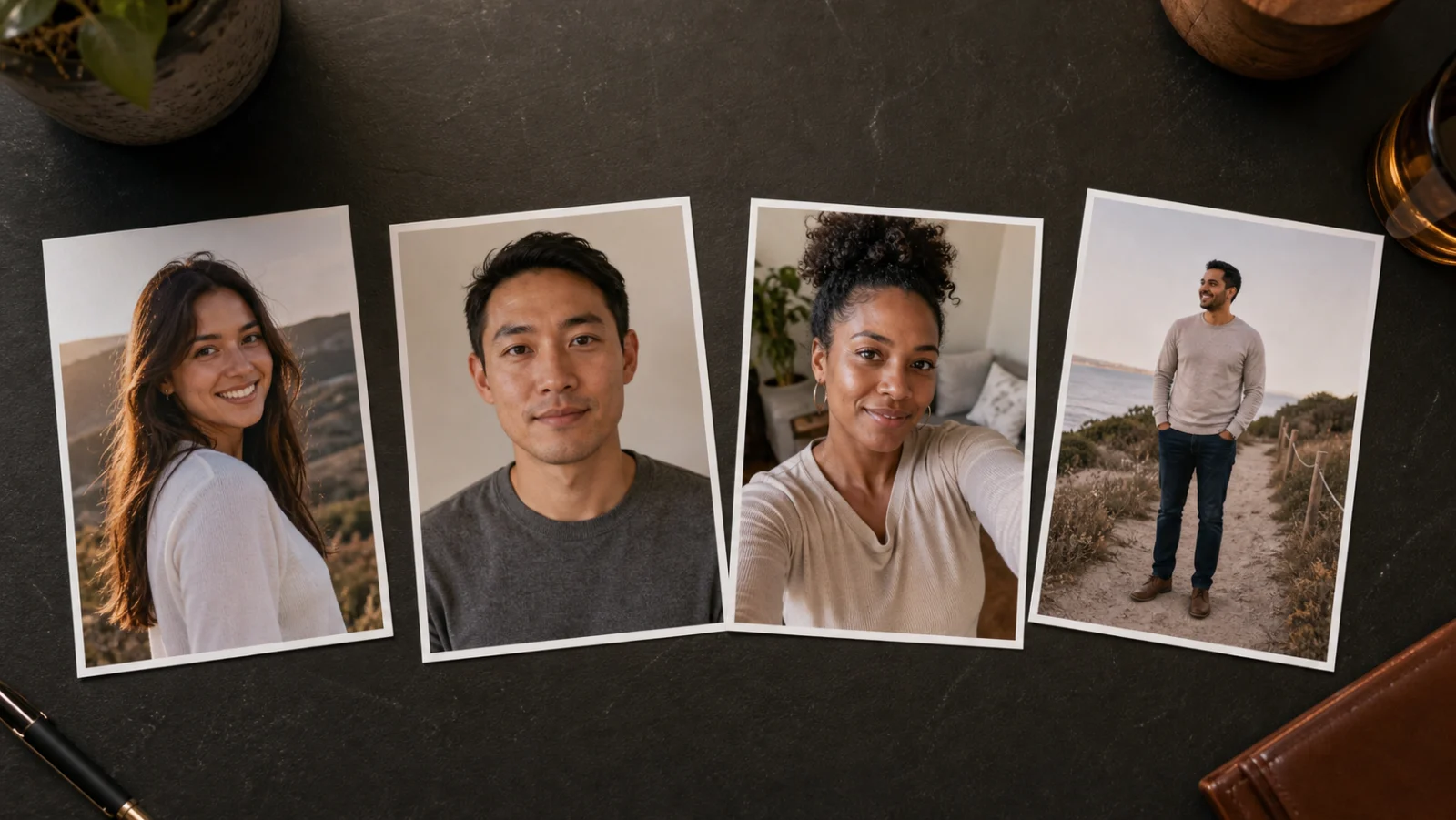
- Privacy: submitted user photos and user-level records are not published. The hero image contains fictional, generated people.
What this data cannot tell us
This is an observational platform sample, not a randomized experiment. Photo traits overlap: selfies are often closer; outdoor photos often have brighter light; full-body photos are more likely to be taken by another person. Gender, age, image quality, and the person in the photo can all influence ratings. The sample is also too small for dependable subgroup claims.
The honest conclusion is therefore narrower than a viral "perfect photo formula": non-selfies performed clearly better in this sample; the other three patterns are useful hypotheses to test on your own photos.
A practical photo lineup
- Lead with a clear, naturally smiling face photo taken from several feet away.
- Add one outdoor or activity image with clean light and an uncluttered background.
- Include one current full-body photo that looks like your real life.
- Use a selfie only when it adds information another photo cannot.
- Test multiple actual frames; averages cannot predict your strongest individual image.
Test the photo, not the rule
Upload your candidates and get anonymous ratings for attractiveness, trustworthiness, and fun.
Test My PhotosRead next
You can check the technical side of any photo yourself with the free dating photo quality checker before asking people to rate it.