Dating App Algorithms: Myths, Truths, and What You Need to Know
By Chris Kerger
Last updated August 8, 2026
Is the algorithm working against you? Are you "shadowbanned"? Or is something simpler going on?
Below: what Tinder, Bumble and Hinge have actually said about how they rank profiles — and, just as importantly, which popular claims nobody has ever verified.
The short version
Five claims you have probably read about dating app algorithms, and what each one is actually worth. Confirmed = the app itself has said so on the record. Unconfirmed = plausible, widely repeated, never verified by anyone with access to the code.
| The claim | Status | What is actually known |
|---|---|---|
| "Tinder ranks you with an ELO score" | Outdated | Tinder used ELO historically and publicly retired it in 2019: "Elo is old news at Tinder. It's an outdated measure and our cutting-edge technology no longer relies on it." Ordering is still algorithmic — just not ELO. |
| "Being active gets you shown more" | Confirmed | Tinder states it recommends profiles using recent activity and "prioritize[s] potential matches who are active, and active at the same time." |
| "Swiping right on everyone gets you punished" | Unconfirmed | No app has ever confirmed a mass-swipe penalty. Tinder says Likes and Nopes are inputs, not that indiscriminate liking is penalised. The observable effect — poor matches — is explained without any penalty. |
| "New accounts get a boost" | Unconfirmed | Not documented by any app. A cold-start system does have to show a new profile widely to learn anything about it, so the effect is plausible — but the size and length of any "boost" is folklore. |
| "I've been shadowbanned" | Usually no | Apps do restrict accounts that get reported or break the rules, and say so in their policies. Sitting low in other people's queues looks identical from your side and is far more common. |
"Tinder ranks you with an ELO score"
- Status
- Outdated
- What is actually known
- Tinder used ELO historically and publicly retired it in 2019: "Elo is old news at Tinder. It's an outdated measure and our cutting-edge technology no longer relies on it." Ordering is still algorithmic — just not ELO.
"Being active gets you shown more"
- Status
- Confirmed
- What is actually known
- Tinder states it recommends profiles using recent activity and "prioritize[s] potential matches who are active, and active at the same time."
"Swiping right on everyone gets you punished"
- Status
- Unconfirmed
- What is actually known
- No app has ever confirmed a mass-swipe penalty. Tinder says Likes and Nopes are inputs, not that indiscriminate liking is penalised. The observable effect — poor matches — is explained without any penalty.
"New accounts get a boost"
- Status
- Unconfirmed
- What is actually known
- Not documented by any app. A cold-start system does have to show a new profile widely to learn anything about it, so the effect is plausible — but the size and length of any "boost" is folklore.
"I've been shadowbanned"
- Status
- Usually no
- What is actually known
- Apps do restrict accounts that get reported or break the rules, and say so in their policies. Sitting low in other people's queues looks identical from your side and is far more common.
Sources for the confirmed rows: Tinder, "Powering Tinder — The Method Behind Our Matching". Everything below is labelled the same way, so you can tell what is documented from what is inference.
One input you fully control: your first photo.
Real people rank your photos head-to-head so you lead with the strongest one.
Do you have a "score" that determines who sees you?
You have a position in other people's queues. Whether that is a single "score" is not public.
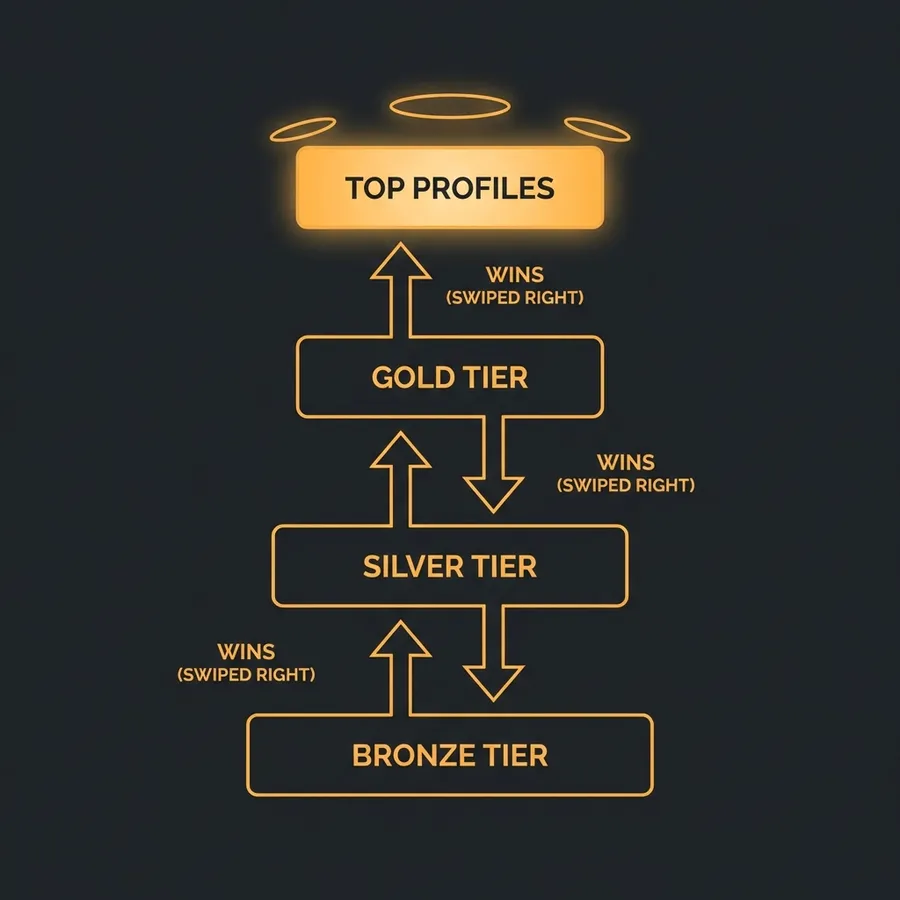
For years Tinder did use an ELO rating — the system borrowed from chess ranking, where being liked by a highly-liked person moved you more than being liked by an unpopular one. That much is history, not speculation. What is also not speculation is that Tinder publicly dropped it in 2019: "Elo is old news at Tinder. It's an outdated measure and our cutting-edge technology no longer relies on it."
What replaced it, in Tinder's own words, is recommendations driven by "recent activity, who members are sending Likes and Nopes to, profile elements like interests, and location." That is a learned ranking model. It certainly produces an ordering. Whether that ordering reduces to one internal "desirability number" per user is the part nobody outside the company can confirm — so treat the popular "your desirability score" framing as a metaphor for how the feed behaves, not a documented mechanism.
What follows from a ranking system of any shape:
- Who you see is filtered and ordered, not random.
- Who sees you depends on where you land in their queue, which you never observe directly.
Practical upshot: chasing a number you can't see is wasted effort. The inputs the app says it uses — recent activity, what you like, and what's on your profile — are all things you can change today.
How do these systems actually work?
It's not just about looks. The algorithm wants to maximize successful connections (matches that lead to chats).
Key factors include:
- Engagement (Do you use the app?)
- Selectivity (How picky are you?)
- Compatibility (Do you match with people who match with people like you?)
- Recency (Are you new?)
#1. Activity & recency Confirmed
This is the one factor an app has stated plainly. Tinder says it "prioritize[s] potential matches who are active, and active at the same time," and that regular use "helps members be more front and center, see more profiles and make more matches."
The logic is obvious from the app's side: showing you a profile that hasn't opened the app in three weeks wastes an impression. A conversation that starts within minutes is worth more than one that starts never.
Takeaway: a short session most days beats one long binge a week. This is the highest-confidence advice in this article.
#2. Selectivity Unconfirmed
The widely-repeated version is that mass right-swiping "gets you punished" by the algorithm. That specific mechanism has never been confirmed by Tinder, Bumble or Hinge, and we're not going to state it as fact.
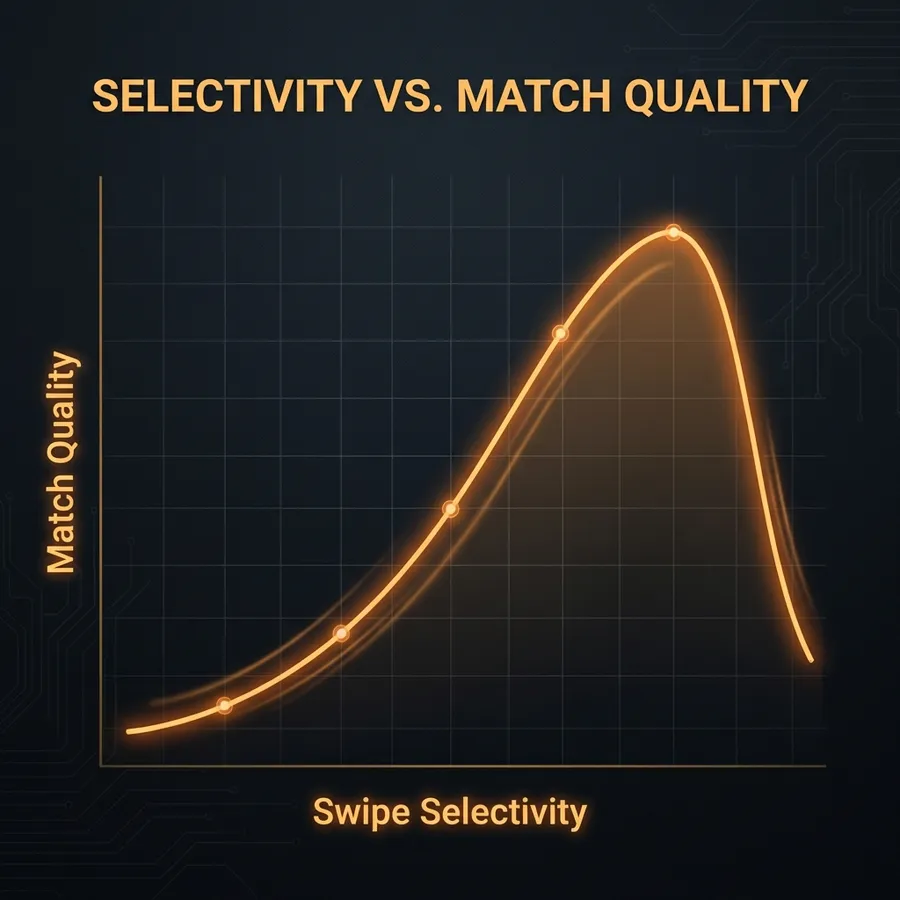
What is documented is that your Likes and Nopes are inputs to what you get shown. If you like everyone, you hand the model no signal about your taste, so it has nothing to personalise on. And separately from any algorithm: liking everyone produces matches with people you didn't actually want, which is where the "my matches are terrible" complaint comes from. You don't need a hidden penalty to explain the outcome.
Bumble's own advice is likewise to swipe deliberately rather than in bulk. Treat "be selective" as sound behaviour with an uncertain mechanism, not as a rule you're being scored against.
#3. The "newbie boost" Unconfirmed
Almost everyone reports a flood of matches in their first days, then a drop. No app documents a deliberate new-user boost, so the honest answer is that we don't know it exists as a designed feature.
There is a plain technical reason the pattern would appear anyway. A recommender knows nothing about a brand-new profile, so it has to show it around to learn — the classic cold-start problem — and a brand-new profile is also, by definition, maximally "recently active", which the app says it favours. Once there's data, your position settles to whatever your profile actually earns. That feels like a boost being switched off; it may just be the model finishing its guesswork.
Either way, the practical advice is the same and doesn't depend on which explanation is right: don't create the account until your photos are ready. The period when you're shown most widely is the period you can least afford a weak first photo.
Get the first photo right before the app decides what you're worth.
Head-to-head votes from real people, not your own guess.
Common Questions & Myths
"Am I shadowbanned?" Usually no
Apps do restrict accounts — that part is real and written into their community guidelines. Reports, spam behaviour and policy violations can get an account limited or removed, sometimes without a clear notice.
But "I get no matches" is not evidence of it. Being placed low in other people's queues looks exactly the same from your side as being hidden, and it is by far the more common explanation. Neither state is visible to you, which is precisely why the theory is unfalsifiable and spreads so well.
A cheap test before you conclude anything: change your primary photo and your first prompt, then use the app normally for a week. A profile that was simply ranking poorly can move. A restricted account generally won't — and if you think yours is restricted, the only real recourse is the app's own support, not a workaround.
"Should I reset my account?" Risky
The delete-and-recreate trick assumes the newbie boost is real and that the app can't tell it's you. Both assumptions are shaky, and the second one is the expensive one to get wrong.
Apps link accounts by phone number, Apple/Google ID, payment method, device and photos. More importantly, recreating an account to evade a restriction is itself against the terms of service on Tinder, Bumble and Hinge — so the manoeuvre that's supposed to fix a suspected ban is the one thing that can turn a suspicion into a real one. Paid subscriptions and existing matches also don't survive.
If you delete purely to start clean and you're in good standing, that's your call — but do it with genuinely better photos, or you'll rebuild to the same place. There is no verified waiting period that makes an old account "forgotten"; any specific number of days you read online, including on this site previously, is made up.
Tinder vs. Bumble vs. Hinge
| Platform | Key Algorithm Priority | Best Strategy |
|---|---|---|
| Tinder | Visuals & Activity | Have high-contrast, clear solo photos. Log in frequently. |
| Bumble | Empowerment & Completeness | Fill out every prompt. Filters are stricter here. |
| Hinge | "Most Compatible" & interaction | Like specific photos/prompts, not just the whole profile. Send comments with likes. |
Tinder
- Key Algorithm Priority
- Visuals & Activity
- Best Strategy
- Have high-contrast, clear solo photos. Log in frequently.
Bumble
- Key Algorithm Priority
- Empowerment & Completeness
- Best Strategy
- Fill out every prompt. Filters are stricter here.
Hinge
- Key Algorithm Priority
- "Most Compatible" & interaction
- Best Strategy
- Like specific photos/prompts, not just the whole profile. Send comments with likes.
Hinge is the one that has been most open about its method: its "Most Compatible" feature is built on the Gale–Shapley stable matching algorithm, the 1962 result that won Shapley and Roth the 2012 Nobel Memorial Prize in Economics. Its point is to predict mutual interest — not just who you'd like, but who would like you back. That's why a like sent with a comment on a specific prompt carries more information than a blanket like. The "best strategy" column above is our inference from each app's public statements and its interface, not an official recommendation from the apps.
Final Thoughts: Can you beat the system?
You can't "beat" the algorithm, but you can work with it. The algorithm is simply a mirror of human behavior.
Your action plan, ordered by how sure we are it matters:
- Fix your primary photo. Whatever the ranking is doing, every viewer sees that image first, and it is the one input nothing else can compensate for.
- Open the app most days. The single algorithm factor an app has actually confirmed in writing.
- Fill out your profile. Tinder lists "profile elements like interests" as an input, and prompts and bios give a human something to reply to. (That empty bios are actively penalised is folklore — but an empty bio still gives nobody a reason to write to you.)
- Reply to your matches. Conversations are what these systems are optimising for, and ignoring matches wastes the ones you earned.
- Update your photos when they stop working. Not because a "freshness boost" is documented — it isn't — but because a photo that hasn't earned matches in a month won't start now.
Almost everything written about these algorithms is inference, including some of what's here — we've marked which is which. The useful part is that the honest advice and the folklore advice mostly point the same direction, and the honest version doesn't require you to believe in a number nobody can see.
Start with the input that matters most.
Find out which of your photos strangers actually pick first.